Placemate

My first award-winning startup.

In classic start-up fashion, Placemate began with a founder frustration. It morphed from a site that matched graduates to jobs based on their personalities (and paid them to apply!) to a data analytics tool for big graduate employers.

From Ireland to Silicon Valley and back, it was a wild ride.

YEAR

2017 - 2020

ROLE

CO-FOUNDER & HEAD OF PRODUCT

CO-FOUNDER & HEAD OF PRODUCT

SKILLS

FULL STACK DESIGN, STARTUP, PRODUCT MANAGEMENT

FULL STACK DESIGN, STARTUP, PRODUCT MANAGEMENT

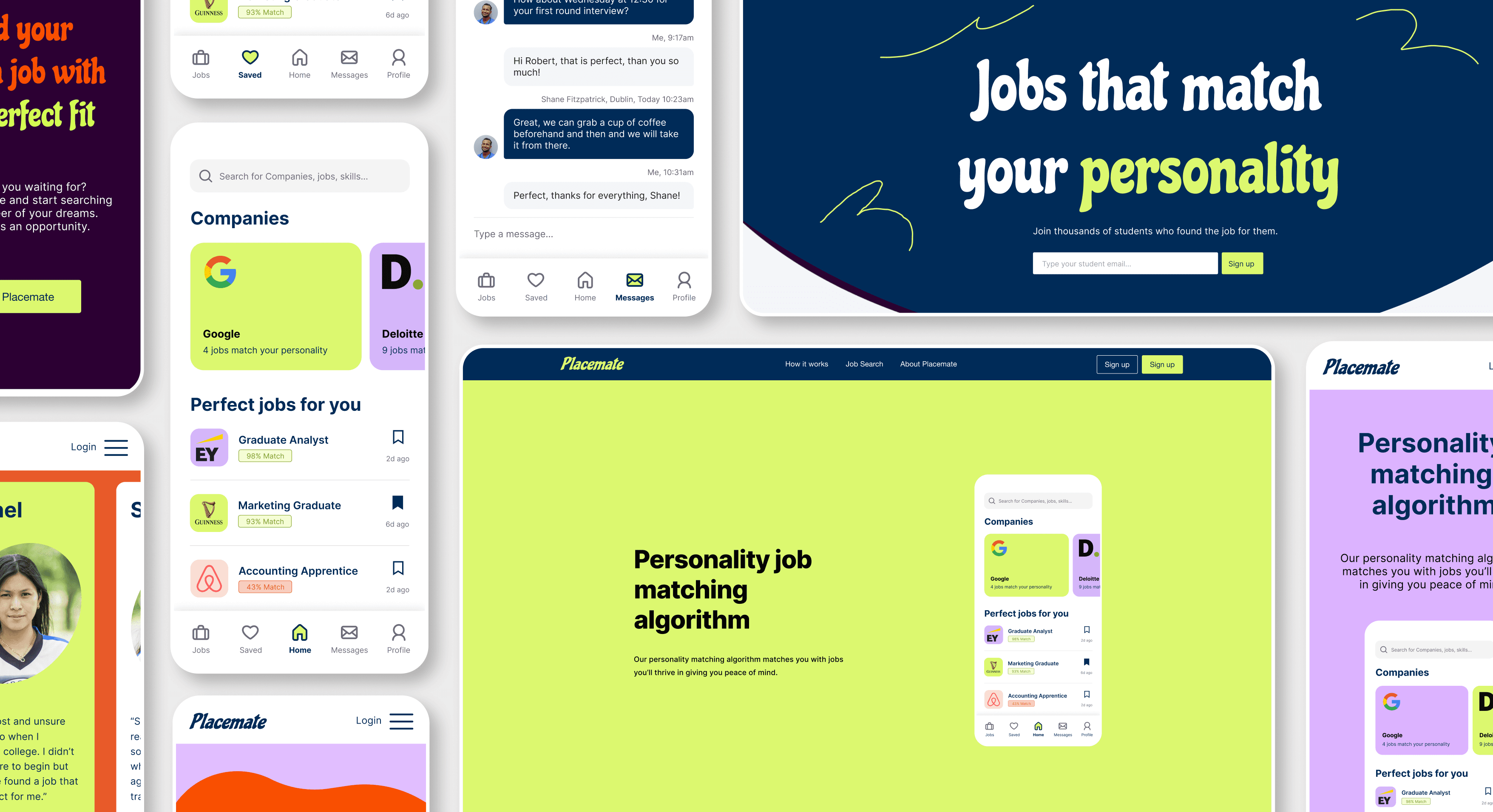
A grid compilation of shots from the Placemate product. Some are mobile, some are desktop. They are set on a beige field with splashes of white, green, navy and purple in the screenshots.

June 2017

The Beginning
The Problem

After graduating from university in 2016 my co-founder and I realised that the early career job market is broken; you need experience to get a job but you need a job to get experience.

Graduates raising their univeristy graduation hats
The Initial Solution

Studies show that hiring people based on their personality fit is a much stronger indicator of potential performance so, in 2017, we decided to create a job site that matches students to companies and jobs based on their personality traits.

My co-founder (a Psychology graduate) designed a personality matching algorithm for this purpose. The site would include an auto-filter so only students who's personality matched a job profile could apply. Initially we wanted to target "Tier 2" companies who couldn’t afford to send teams to college campuses to recruit graduates.

My role in our small team was as the Head of Product and Sales. The two areas work well together as the product feedback I received in sales meetings shaped our product into something customers wanted to buy.

The Business Model

We charged companies using a SaaS model to avoid the seasonality of graduate hiring but we knew this wouldn't work when we had no student users. Therefore, we made the product free for companies to post job ads (which would attract students). Companies would then pay a small fee if applicants matching their requirements applied and they would pay a hiring fee if they hired someone.

An applicant fee became our main method of attracting student users; we gave them €5 for each qualified application they made. This led to thousands of student users joining the platform and was our attempt to avoid the "chicken and egg" problem common in marketplace start-ups.


Mistake #1

No one tells you your baby is ugly.
A gradient blue circle that changes from light to dark blue.
A gradient purple circle that changes from light to dark purple.
A gradient lime green / yellow circle that changes from lime green to lemon yellow.

Mistake #1

No one tells you your baby is ugly.
A gradient blue circle that changes from light to dark blue.
A gradient purple circle that changes from light to dark purple.
A gradient lime green / yellow circle that changes from lime green to lemon yellow.

Mistake #1

No one tells you your baby is ugly.
A gradient blue circle that changes from light to dark blue.
A gradient purple circle that changes from light to dark purple.
A gradient lime green / yellow circle that changes from lime green to lemon yellow.

Mistake #1

No one tells you your baby is ugly.
A gradient blue circle that changes from light to dark blue.
A gradient purple circle that changes from light to dark purple.
A gradient lime green / yellow circle that changes from lime green to lemon yellow.
How (NOT) to do User Research

I conducted user research with university students and faculty members. They liked the idea. I spoke with over 30 employers and they liked it too.

But this was our first big mistake; we showed both groups what we were thinking and asked for feedback. We asked leading questions and we heard the answers we wanted to hear. People are inherently nice and will rarely tell you how bad your idea is to your face. We would find this out later the hard way.

Product Design

We ran some fairly rudimentary branding exercises to select colours and fonts for our website. We made a very basic design system which defined the key elements.

Even though our paying customers were businesses, we knew that, in terms of total user numbers, more students would be visiting the site.

Therefore the homepage was designed to look like a job search engine with these students in mind.
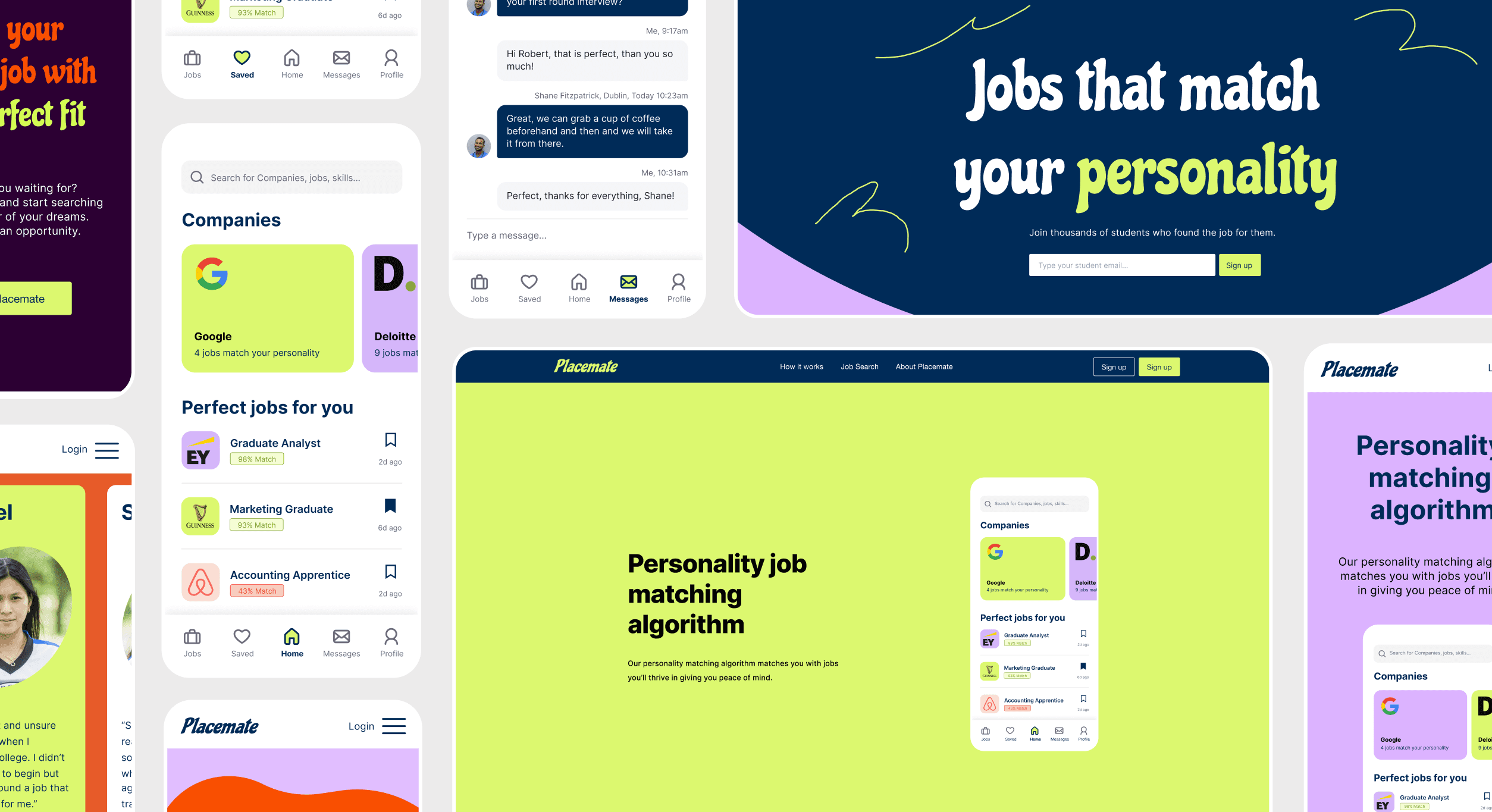
Grid of colourful Placemate website screenshots.

July 2018

Placemate 1.0
Full-time via an Accelerator

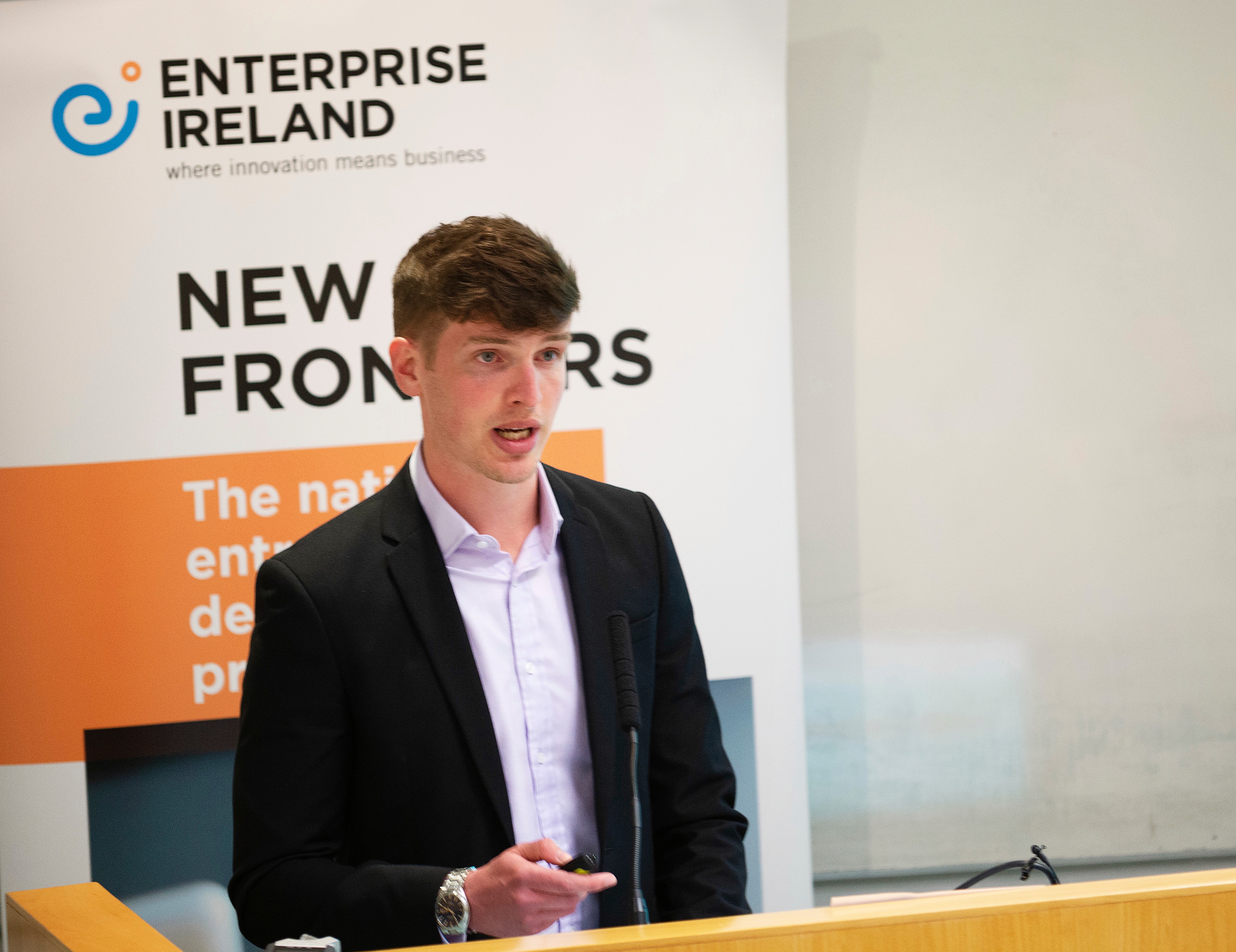
In July 2018 we won a place on a fully funded 9 month accelerator program called New Frontiers. The programme is run by the Irish government to fund promising startups.

We assembled a team, hired some developers and began turning our idea into a reality. We used FullStory to watch user sessions, run A/B tests and to improve our signup flow with our early users.

Mistake #2

Building before selling.
A gradient blue circle that changes from light to dark blue.
A gradient purple circle that changes from light to dark purple.
A gradient lime green / yellow circle that changes from lime green to lemon yellow.

Mistake #2

Building before selling.
A gradient blue circle that changes from light to dark blue.
A gradient purple circle that changes from light to dark purple.
A gradient lime green / yellow circle that changes from lime green to lemon yellow.

Mistake #2

Building before selling.
A gradient blue circle that changes from light to dark blue.
A gradient purple circle that changes from light to dark purple.
A gradient lime green / yellow circle that changes from lime green to lemon yellow.

Mistake #2

Building before selling.
A gradient blue circle that changes from light to dark blue.
A gradient purple circle that changes from light to dark purple.
A gradient lime green / yellow circle that changes from lime green to lemon yellow.
Sluggish Sales

"Yeah it’s a nice idea but we just don’t have the budget for it right now".

After investing resources into building a product, by February 2019 we were met with this answer on a regular basis when we pitched our idea to the companies we had interviewed in our user research phase.

We learned the hard way that validation only comes when a customer is willing to pay for your product. Despite making some sales, growth wasn’t nearly as fast as we had forecast.

Mistake #3

Features don’t solve your business model.
A gradient blue circle that changes from light to dark blue.
A gradient purple circle that changes from light to dark purple.
A gradient lime green / yellow circle that changes from lime green to lemon yellow.

Mistake #3

Features don’t solve your business model.
A gradient blue circle that changes from light to dark blue.
A gradient purple circle that changes from light to dark purple.
A gradient lime green / yellow circle that changes from lime green to lemon yellow.

Mistake #3

Features don’t solve your business model.
A gradient blue circle that changes from light to dark blue.
A gradient purple circle that changes from light to dark purple.
A gradient lime green / yellow circle that changes from lime green to lemon yellow.

Mistake #3

Features don’t solve your business model.
A gradient blue circle that changes from light to dark blue.
A gradient purple circle that changes from light to dark purple.
A gradient lime green / yellow circle that changes from lime green to lemon yellow.
Solving a Nonexistent Problem

Despite adding new features and services at customer requests, no amount of new features could save our product because the problem it solved was just not pressing enough. In fact, we found later that less is more when it comes to features.

We had solved a pressing problem for student users but not for paying customers and features couldn't change that.

May 2019

Placemate 2.0
User Research Take #2

By May 2019 it was clear that our current strategy was not working; we did not have Product-Market fit. We decided to start a fresh round of user research but this time we went in to companies to listen, not to pitch.

We learned that big graduate employers actually don’t need help getting more or higher quality graduate applicants; they have recruitment teams that go to on-campus events to recruit students for them.

However, their teams had no idea how many hires they made from each event, in which sectors they were etc. That was like spending tens of thousands of euro on Facebook ads and having no insight into how many people clicked through. This metrics black hole meant HR teams were not getting the recognition their work deserved and they couldn’t track their ROI; it was a pressing issue for them.

Pivot, Pivot, PIVOT!!!

By June 2019 we had realised our mistake and were considering making a critical pivot.

Our new concept was for a platform that allowed companies to quickly capture student data at on-campus events. Companies could then segment students and, crucially, our system would allow them to track ROI, quantify their HR teams' work and improve their processes with detailed hiring metrics.

Armed with nothing more than a Figma prototype and slide deck, we made our pitch to some big graduate employers. Within a fortnight of presenting Placemate 2.0 we had generated several thousand euro in sales before writing a single line of code.

PIVOT Meme from Friends, Ross carrying a couch up stairs.
Rapid Deployment & Iterating

Now that we had a new concept that was generating sales at a much faster rate, we needed to build out the platform.

Learning from our previous mistakes, we opted to build a simplified MVP and to iterate based on the feedback we got from customers once they actually started using the product.

A beta version of the new site was built in less than a week. This time we focused on our customers’ goals instead of features; capturing data quickly and generating metrics.
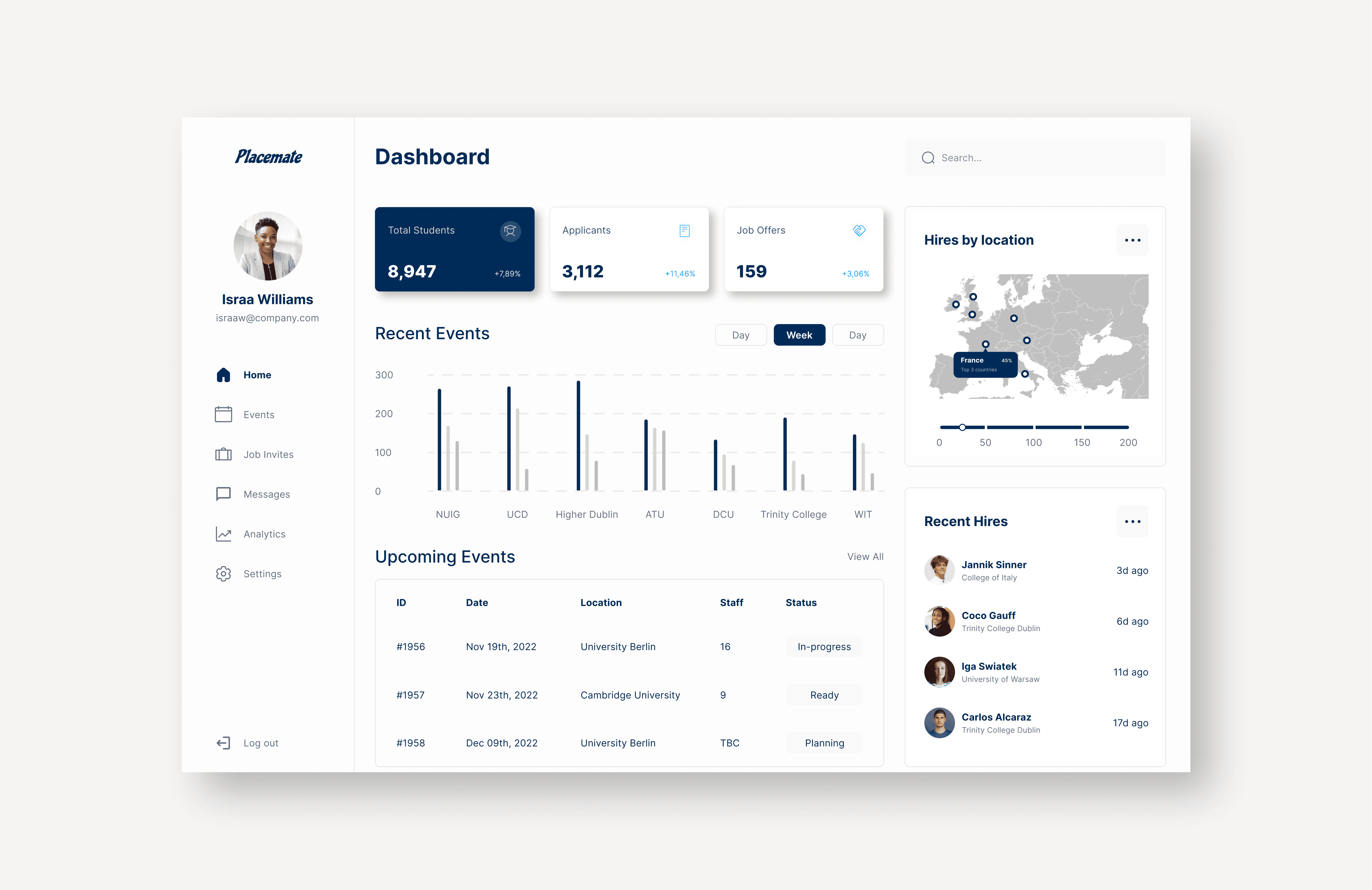
A shot of the Placemate employer dashboard. The dashboard shows some key numbers in a company's student recruitment efforts.
Real Traction

The new site (placemate.io) continued to gain traction and won multinational and Fortune 500 company clients. We had even agreed an EMEA wide rollout of our product a larger client.

We were invited to exhibit at the StartUp Grind Global Conference in Silicon Valley where we raised a pre-seed funding round with a commitment to a $500,0000 seed round in 12 months’ time if we hit our metrics. Finally we felt like Placemate was really taking off!

Covid-19

Despite all the mistakes we made along the way (and there were oh so many, many mistakes) a bat in Wuhan put Placemate out of business.

When the pandemic struck Europe all of the on-campus university recruitment events were cancelled and without them our clients had no need for our product. In July 2020, after toying with the idea of pivoting into the virtual event space, countries that had lifted Covid restrictions began to re-enter lockdowns. It was clear that the time was no longer right for Placemate and the team took the difficult decision to break up.

It was an unfortunate ending to a truly great ride.

August 2020

Conclusions
Lessons Learned

Co-founding and running Placemate has taught me so much about business and product which I have been able to apply to the companies I have worked for subsequently.

From coming up with an idea, making it a reality, building a team, pitching solo in the board rooms of Fortune 500 companies, raising money in Silicon Valley as well as all the knocks and setbacks along the way; Placemate has been an incredibly challenging but rewarding experience.

Some key learnings include:

  • Idea, sell then build; don’t build before speaking with customers

  • Don’t give free trials; payment is the best product validation

  • When doing user research don’t ask leading questions

  • In fact, when doing user research aim to speak less than 10% of the time; listen instead

  • Adding features won’t save a business

  • Simpler products are best if they solve a real pain

  • I learned to use new software tools like Figma, Fullstory, Canva and more.

  • As a team we built a resilience to hearing "No"

  • I learned not to take business personally

  • I learned to regulate emotions (highs and lows) in a fast paced environment

  • I learned to sell (although it still makes me uncomfortable)

  • We all learned to work through the Build, Measure, Learn, Iterate feedback loop as quickly as possible and to never stop doing it!

  • There is no feeling in the world like the startup rush.​

I put these lessons into practice in my second startup; 100 Tree Furniture.

Awards
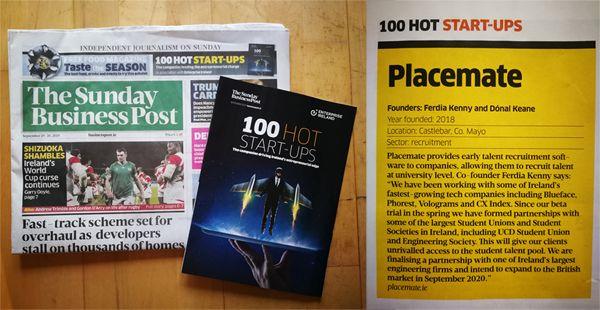
  • Sunday Business Post’s Hot 100 Startups of 2019

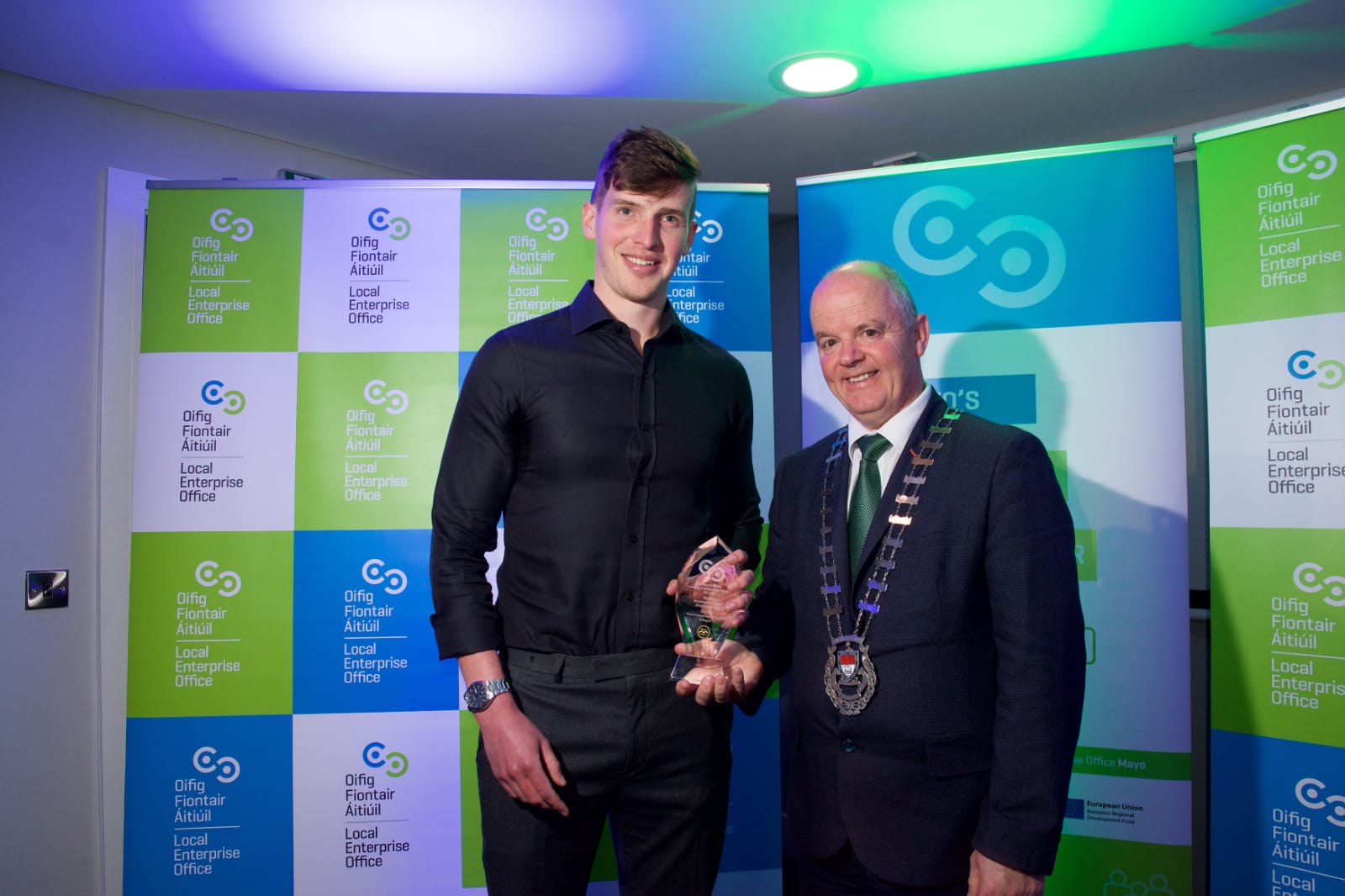
  • Ireland’s Best Young Entrepreneur regional runner-up

  • Invited to exhibit at Startup Grind Global Conference, Silicon Valley 2020

  • Invited to exhibit at Dublin Tech Summit 2020

  • Invited onto DTS Vision X programme

  • Shortlisted for Seedcorn 2019 Best New Startup

  • ITAG Excellence Awards shortlist for best emerging tech startup 2019

  • Irish Student Entrepreneurship Forum national runner-up, 2018

  • Mayo Business Awards “Best Technology Business Award” shortlist

  • Won a place on the 9 month funded accelerator; New Frontiers

  • Selected for the Enterprise Ireland International showcase, Croke Park 2019

Customers
  • Northern Trust

  • Blueface

  • Carraig Donn

  • Carne Group

  • Storm Technology

  • Zenith Technologies

  • Towercom

  • Danalto

  • CX Index

  • Volograms

  • Capventis

  • Oathello

  • Node Architects

  • Phorest

  • Pathfinder

Lessons Learned

Co-founding and running Placemate has taught me so much about business and product which I have been able to apply to the companies I have worked for subsequently.

From coming up with an idea, making it a reality, building a team, pitching solo in the board rooms of Fortune 500 companies, raising money in Silicon Valley as well as all the knocks and setbacks along the way; Placemate has been an incredibly challenging but rewarding experience.

Some key learnings include:

  • Idea, sell then build; don’t build before speaking with customers

  • Don’t give free trials; payment is the best product validation

  • When doing user research don’t ask leading questions

  • In fact, when doing user research aim to speak less than 10% of the time; listen instead

  • Adding features won’t save a business

  • Simpler products are best if they solve a real pain

  • I learned to use new software tools like Figma, Fullstory, Canva and more.

  • As a team we built a resilience to hearing "No"

  • I learned not to take business personally

  • I learned to regulate emotions (highs and lows) in a fast paced environment

  • I learned to sell (although it still makes me uncomfortable)

  • We all learned to work through the Build, Measure, Learn, Iterate feedback loop as quickly as possible and to never stop doing it!

  • There is no feeling in the world like the startup rush.​

I put these lessons into practice in my second startup; 100 Tree Furniture.

An image that shows Placemate being featured in the Sunday Business Post's list of Hot 100 Startups of 2019.
Ferdia Kenny winning the runner-up prize for the highly prestigious Ireland's Best Young Entrepreneur (IBYE).
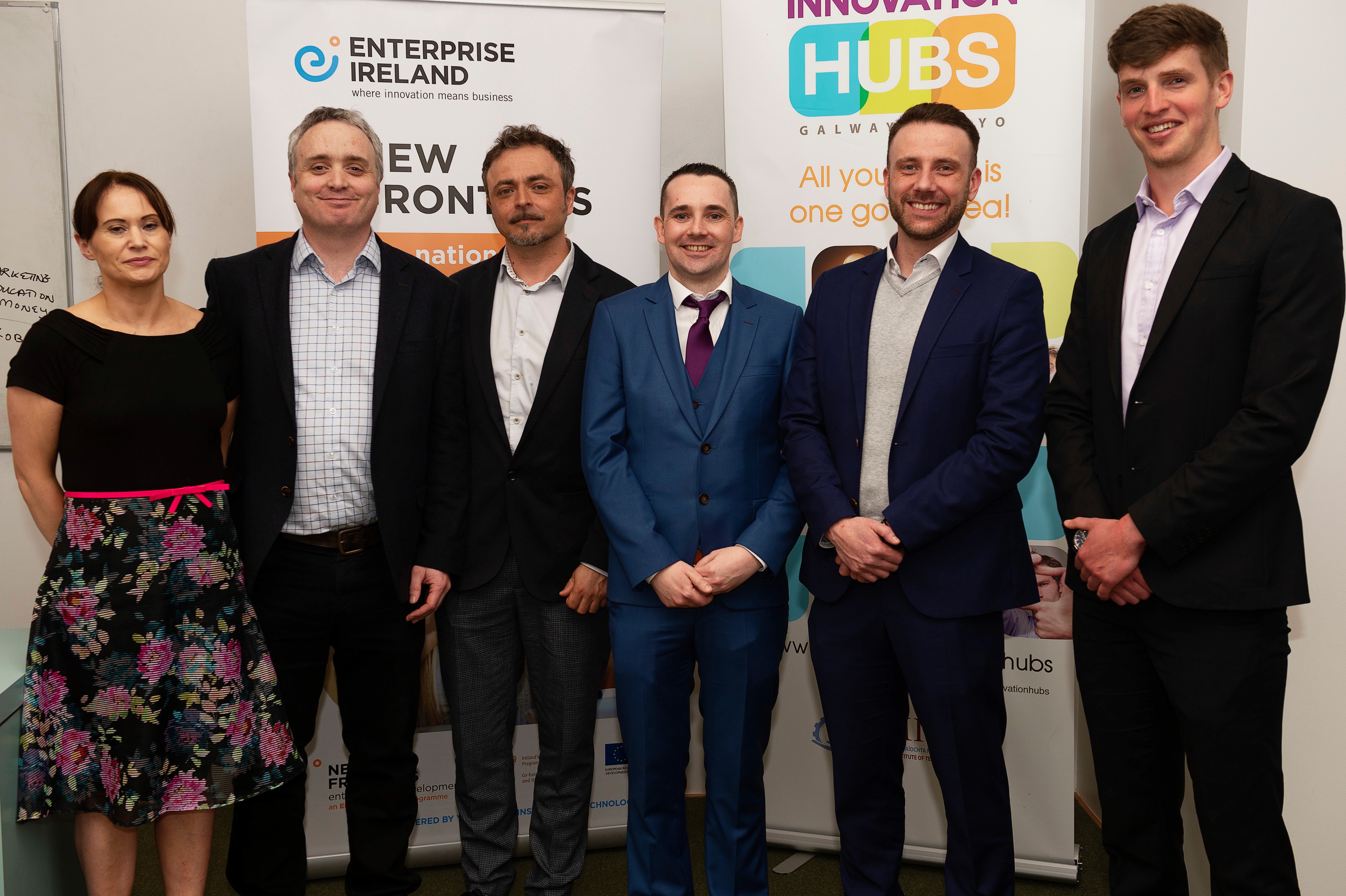
Ferdia Kenny with five other people at the Enterprise Ireland New Frontiers Phase 3 final startup pitch day.
Ferdia Kenny presenting at the Enterprise Ireland New Frontiers Phase 3 final startup pitch day. He is wearing a black suit and is pitching in front of an Enterprise Ireland banner.